Support services that enhance Indigenous Anti-Racism, Decolonization, Human Rights, Cultural Safety and Humility
These services include space and weight for sex, gender, and sexuality diversity and human rights, including room for the experiences and rights of Two-Spirit and Indigiqueer peoples.
|
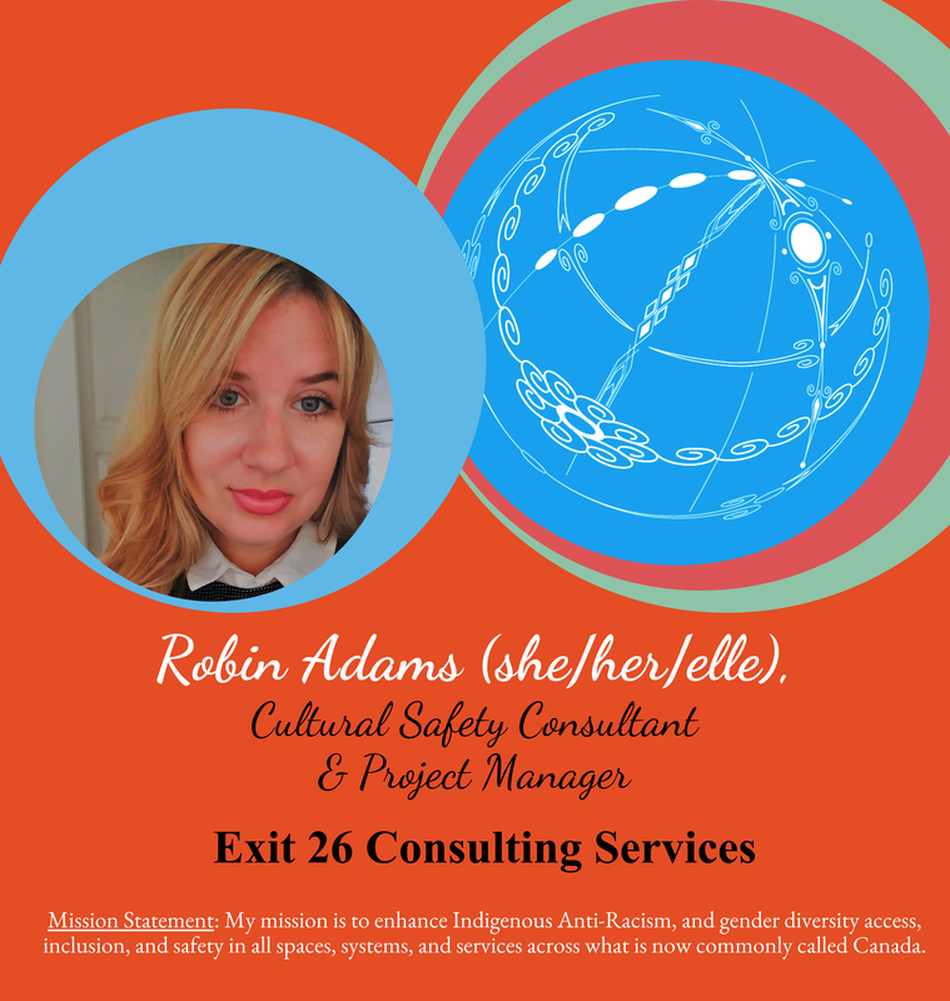
Robin Adams (she/her/elle),
Cultural Safety Consultant Would you like to know more, but not quite sure where to start? Some people sometimes also feel like they need to explore the topic of Indigenous Anti-Racism in their workplace, but are unsure how to ask about this topic respectfully and in the "right language". I invite you to a free one-hour consultation over Zoom, where I can share a safe online space to have an open conversation about my services that enhance Indigenous Anti-Racism. Send me an email to set up a no-charge, no-pressure, initial conversation and consult. |
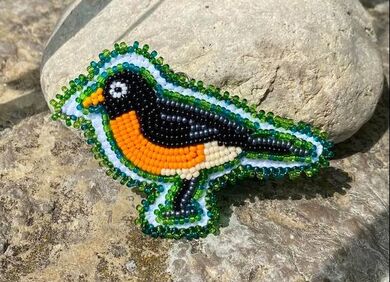
Beading is medicine.
Indigenous health and healing methods are important, valid, and current today.
Photo by Julie Spratt, 2023.
When meeting with me over a Zoom call, you might see me wearing my beaded robin pendant, handmade by Julie Spratt who self-identifies as an Anishinaabe kwe from Nipissing First Nation. I'm honoured that Julie allows me to share a bit of her story here. Julie shares with me that a life-altering illness and the passing of her gookmis brought Julie, a ‘60’s Scoop survivor, to reconnect with her ancestral and cultural community. She found beadwork as healing medicine. Julie says: “Then when my illness took almost everything, I turned to the beads. I had no idea that the beads could teach me mino-bimaadzawin. As I develop this relationship with my beadwork, I learn the greatest lessons in patience and humility, listening intently. I soon declared "I bead to live" - literally!” Click here to visit Julie’s page on the Indigenous Arts Collective of Canada website. Miigwetch.
About the Name: Exit 26 Consulting
I grew up in the city of Victoria, British Columbia, Canada; the largest city on what is now commonly called Vancouver Island. When driving to the Victoria International Airport, one takes Exit 26 from the highway. I have spent time in 21 countries and many diverse cultural communities as a traveler, student, volunteer, and/or resident. These international experiences have informed my personal, academic, professional, and humanitarian initiatives in a meaningful way, and all of those experiences started by taking Exit 26.
The lands and waters now commonly called Victoria are the ancestral and treaty territory of the lək̓ʷəŋən
(Lekwungen) peoples, the Songhees and Xwsepsum (Esquimalt) First Nations, as well as the SENĆOŦEN speaking peoples of the W̱SÁNEĆ Nations.
About the Logo
Logo Created by Carrie-Anne Abernethy of Creative Gravity Graphic Design.
The Exit 26 Consulting logo is a representation of the beauty found in cultural diversity across the earth. The strands in this globe collectively symbolize the sociocultural strengths of the many distinct cultural communities that together make up the world. People everywhere have become more interconnected in recent human history, and it is increasingly more important that we see ourselves as global citizens. Increasingly, Indigenous peoples across the globe are connecting to collaborate on different forms of decolonization from language revitalization to territory governance. I look to this meaningful symbol to remember important values in my anti-racism work that makes systems, services, and spaces more accessible, relevant, and safe for Indigenous, and gender diverse peoples.